


While donors are exposed daily to a growing number of solicitations and appeals for donations, capturing the public's attention and gaining their trust becomes a major challenge for charitable organisations.
Fundraising today increasingly relies on one key factor: a charity’s ability to make its impact concrete, understandable and credible.
However, trust is not built solely on figures or activity reports. It is also built by the way a charity tells its story and reveals the transformations that it makes possible.
For Millennials and Gen Z, this narrative dimension is even more crucial. Accustomed to consuming short, visual, and engaging content, these generations expect charities to tell their story in an authentic and transparent way.
Storytelling is not simply a communication technique. It corresponds to a fundamental decision-making mechanism. Among donors: individuals understand, remember and share a cause much more easily when it is embodied in a story.
In this article, we will analyse why storytelling has become a strategic lever for online charity fundraising, particularly among Millennials and Gen Z. We will also see how organisations can integrate these stories into their fundraising strategy, throughout the donor journey.
Finally, we will see how storytelling can evolve towards a logic of “storydoing” where donors no longer just want to hear a story, but actively participate in it.
Why storytelling is a key lever for charity fundraising
Why Millennials and Gen Z respond particularly well to storytelling
Storytelling and charity fundraising: an impact throughout the donation journey
Storytelling or storydoing: when donors become actors in the cause
Storytelling, trust and loyalty: a strategic challenge for charities
Why storytelling is a key lever for charity fundraising
Fundraising campaigns often emphasise rational arguments: the urgency of a cause, financial needs, or results achieved. These elements remain essential, but they are not always enough to trigger action.
Storytelling is a series of narrative techniques used in communication, allowing information to be transformed into a story that is understandable and memorable.
When it is part of the narrative associated with charity fundraising campaigns, storytelling makes the impact more tangible and creates an emotional bond between the donor and the cause.
Cognitive science confirms this phenomenon: when a person listens to or reads a story, several areas of the brain are activated to mentally simulate the situation described.
A well-documented phenomenon in behavioural psychology, called the ‘identifiable victim effect’, shows that individuals are much more inclined to act when a cause is embodied by an identifiable person rather than through abstract statistics.
In other words, a donor is often more likely to support the story of a specific child, family, or community than to react to overall figures, even if those figures describe a broader reality.
This is precisely what storytelling allows: transforming a complex problem into a human story with which donors can identify.
In the context of charity fundraising, this means that a well-constructed story can help donors understand concretely what their support makes possible and encourage their commitment to a cause.
Why Millennials and Gen Z respond particularly well to storytelling
New generations are the donors of tomorrow and therefore play an increasing role in the philanthropic ecosystem. However, when it comes to giving and volunteering, the expectations of these young supporters differ from those of previous generations, paving the way for new giving habits.
Indeed, several studies show that Millennials and Gen Z place particular importance on authenticity, transparency, and proof of impact when they choose to support a cause.
Unlike previous generations, these donors are no longer satisfied with institutional messages or generic arguments, but want to understand concretely
-
who is being helped,
-
how donations are used,
-
and what real change their contribution helps to create.
Storytelling perfectly addresses these expectations. By embodying a cause through testimonies, field reports, or stories of beneficiaries, it makes the impact more tangible and credible.
These habits are also explained by the media environment in which these generations grow up. Millennials and Gen Z consume narrative content on platforms like Instagram, YouTube or TikTok, where short formats and personal stories occupy a central place.
On TikTok, for example, some organisations use short video formats to tell the story of a beneficiary or explain a cause. For example, the NGO Innocence Project, which fights against wrongful convictions, has generated millions of views through videos recounting the journey of unjustly convicted people and inviting users to share these testimonies.
These formats are often based on a logic of peer recommendation where the members of a community themselves become ambassadors of the narrative.
This approach is particularly suited to the expectations of Gen Z, who often place more trust in personal accounts and lived experiences than in institutional messages.
To discover more strategies for reaching and engaging digital natives and strengthening your online fundraising among younger generations, explore our article: Fundraising: How to reach Generation Z?.
Storytelling and charity fundraising: an impact throughout the donation journey
In an online donation journey, storytelling can influence several key stages. We encourage you to use this technique throughout the entire donation process, from your acquisition campaigns to your thank-you messages and post-donation communications.
1. Attract attention
Even before your donation page, you must capture attention in an information-saturated environment.
Stories allow you to create an entry point. They are much more engaging than a simple call for donations. They spark curiosity and encourage internet users to learn more before even making a first donation.
Several storytelling formats prove particularly effective at this stage.
Testimonies and field accounts
Testimonials from beneficiaries, volunteers, or those working on the ground help to embody a cause and make it more tangible. Thus, a short video, a personal story, or a series of photos can evoke emotion and encourage internet users to delve deeper into the organisation.
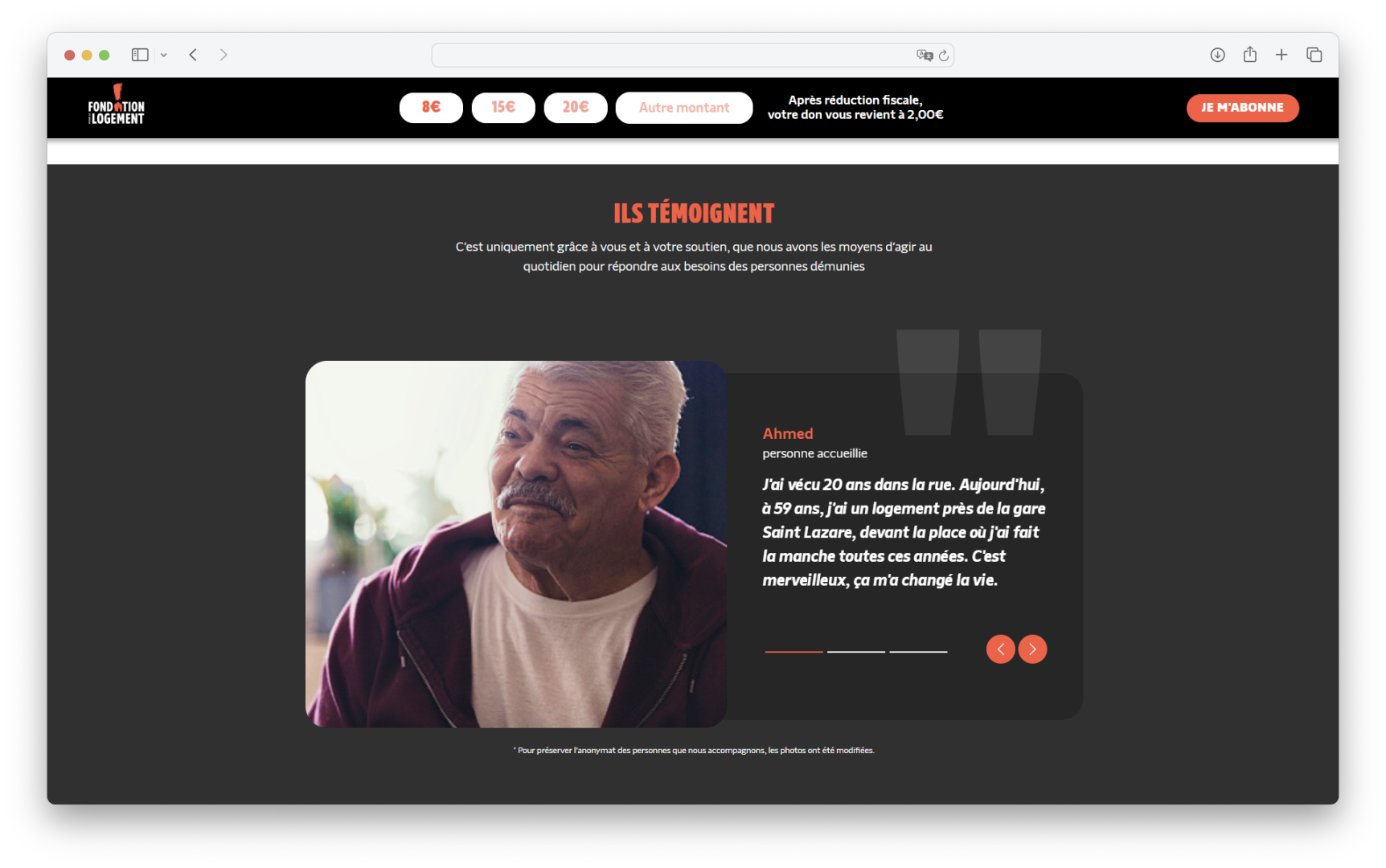
For example, In France, the Fondation pour le Logement des Défavorisés highlights testimonials from beneficiaries and donors in its solidarity monthly subscription campaign. The page associates personal stories to photos of the beneficiaries. This gives a human face to the cause and allows visitors to connect with the shared stories, thereby encouraging donor engagement.
Visual storytelling on social media
Some campaigns use narrative codes specific to social media to reach a wider audience.
One example is that of WWF Belgium who paid tribute to Noëlla, a female wolf who was instrumental in the species' return to Flanders. In a LinkedIn carousel, the organisation combined the photo of the animal with a testimony from a field expert on wolves, discussing its role and the challenges of cohabitation with humans.
This format, both engaging and educational, transforms a complex subject into an accessible and engaging story. In that way, WWF Belgium illustrated the ability of storytelling to create a strong emotional connection and to mobilise communities around a cause.
Immersive experiences and gamification
Some organisations go even further by offering interactive experiences that allow the public to immerse themselves in a story.
Amnesty International Argentina, for example, partnered with MetaMinding Lab to create Escape to Freedom, a game on the Roblox platform which immerses players in the experience of a refugee’s journey. By combining storytelling, exploration and challenges, this experience raises awareness among participants about the reality of migration while inviting them to support the cause.
This type of initiative illustrates the evolution of storytelling towards more participative formats where the public no longer simply discovers a story, but can experience it.
2. Maintain engagement on the donation page
The decision to donate is often made directly on the campaign page or the donation form. It is therefore essential to extend the storytelling to this stage by incorporating, for example:
-
testimonies
-
photos of the field
-
impact stories
-
donation equivalencies
-
simple indicators explaining how donations are used
These elements maintain emotional engagement until the moment of contribution and reduce the hesitations that can arise just before a donation is validated.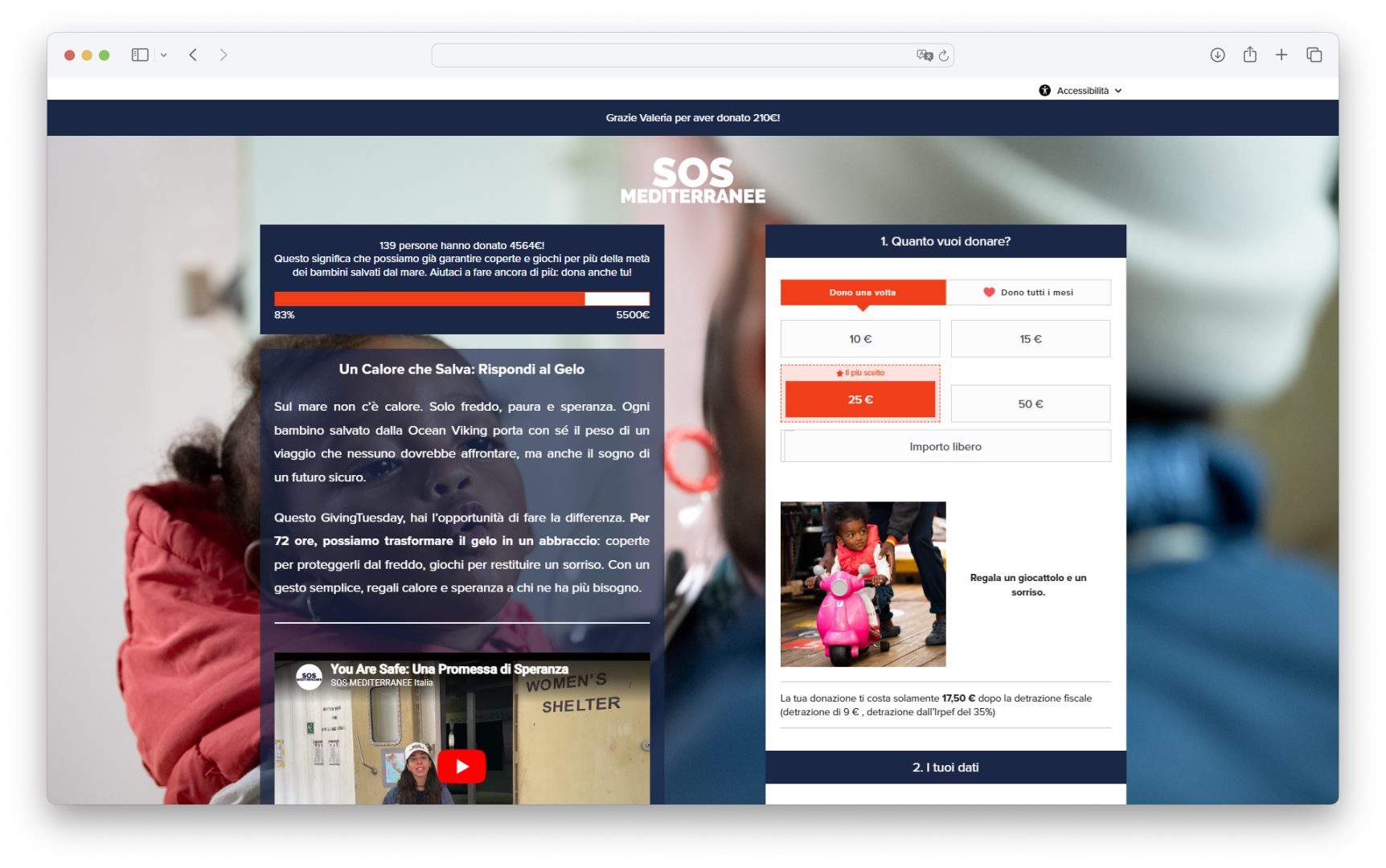
For example, as part of its GivingTuesday campaign,the association SOS Mediterranée Italy demonstrated the impact of its actions by:
-
Integrating a video directly into the donation form to convey both urgency and emotion, thereby strengthening commitment and emotional connection to the cause.
-
Using donation equivalencies to show what the funds raised will support.
-
Including a link to download the full project impact report, promoting transparency.
You can also choose to use storytelling in a more specific way, for example by:
-
Adapting your donation forms according to the donor's profile (new donor, regular donor, specific campaign, etc.), in order to offer a more relevant and personalised story.
-
Using A/B testing to test different narrative formats and target them to different categories of donors, using your CRM solution. For example, by testing:
• email hooks,
• different versions of a donation page,
• or even different stories for the same cause.
This type of A/B testing will allow you to identify the messages that generate the most engagement and donations from your different donor segments.
Example: During an A/B test conducted by the French Brain Institute, the simple act of replacing the form's background image with a more emotional and embodied visual increased the average donation by 29%. This demonstrates that storytelling plays a key role in the giving experience itself, directly influencing the donor's perception and propensity to give.

Looking for A/B testing ideas for your donation form? Get inspired by proven test ideas in our fundraising guide:11 A/B tests to launch to boost your online fundraising.
3. Building trust after the donation
Storytelling doesn't end with the contribution: it also plays a key role in donor loyalty. After their donation, donors want to understand what their support has actually made possible.
Share impact stories supported by concrete data
Nearly 70% of Gen Z donors report that impact reports encourage them to give more.
We advise you to link your stories to concrete impact data, for example:
-
the number of beneficiaries
-
measurable results obtained
-
the evolution of projects
This combination of narrative and proof will strengthen trust in your non-profit organisation.
For example, some organisations incorporate visual elements explaining the distribution of donations or the progress of a project directly into their communications, particularly in their thank-you letters.
Don't underestimate the impact of post-donation communications
Contrary to some preconceived notions, younger generations are particularly sensitive to thank-you letters received by mail. Indeed, 57% of Gen Z donors say that receiving a thank-you letter encourages them to renew their donation. (Source : Blackbaud Report - Gen Z at the table).
Although this aspect is often underestimated by digital fundraising professionals, these results show the importance of continuing to share evidence of impact and messages of appreciation after the donation.
Storytelling or storydoing: when donors become actors in the cause
Beyond simply telling a story, organisations are increasingly seeking to involve donors in this story.
Storytelling is thus evolving towards an approach of storydoing: supporters no longer just want to hear about a cause, but wish to actively participate in its development.
In this approach, donors themselves become actors in the narrative: by sharing a campaign, by creating their own peer-to-peer fundraising page, by participating in an online charity event or a solidarity challenge.
A striking example is that of the Norwegian association Aktiv mot kreft. During the New York Marathon, the organisation partnered with an influencer who shared his entire challenge (from training to the race) with his community. His fundraising page raised over €18,000 to support the charity's missions. To learn more: Peer-to-peer fundraising: how Aktiv mot kreft raised €770,000.
This type of campaign illustrates the correlation between storytelling and Community Fundraising events.
Looking for simple and effective charity fundraising event ideas? Explore our article: 10 simple fundraising event ideas to boost your cause.
Storytelling, trust and loyalty: a strategic challenge for charities
Recent studies show that trust becomes a determining factor in online fundraising, directly influencing the likelihood of donations and donor retention. Indeed, according to the Edelman Trust Barometer 2025, transparency and proof of impact are among the most decisive criteria in the decision to support an organisation.
In this environment where attention is scarce and trust fragile, nonprofits that manage to tell true stories have a decisive advantage in mobilising and retaining their donors.
Storytelling plays a key role here: by embodying the causes and showcasing the transformations made possible by donations, it allows organisations to:
-
make the impact visible
-
humanise the organisation's mission
-
create a lasting emotional connection with donors
-
strengthen the transparency and credibility of your charity's activities
By combining human stories, impact data and transparency, you will have a strategic advantage for your next online fundraising campaigns.
Beyond numbers and results, it is often the stories that make donors want to get involved, share a cause and remain engaged in the long term.
To explore in more detail how to build an engaging narrative and invite your donors to become actors of change, see our article: The art of storytelling in online fundraising.