


Recent studies show that donor behaviour is evolving, influenced by socio-economic, demographic, and technological factors. Understanding these dynamics is essential to adapt your charity fundraising strategy, reconnect with donors who may feel hesitant or disengaged, and lay the foundations for long-term relationships.
In this article, we explore what global research tells us about how donor behaviour is changing. You will discover how donor trust now relies on one key element: transparency.
Why donor trust should stand at the heart of your charity fundraising strategy
1. Understanding how donor trust is evolving
2. Barriers to giving and donor expectations
3. How younger generations (Gen Z, millennials) are redefining the donor relationship
New generations: beyond immediate giving, thinking long-term relationships
What this means for your charity fundraising strategy
This article sits within a broader context. Giving habits are evolving, expectations around impact are increasing, and younger generations are redefining their relationship with charities.
Organisations must therefore rethink their practices to raise funds effectively while strengthening donor trust, particularly by ensuring transparency.
Why donor trust should stand at the heart of your charity fundraising strategy
1. Understanding how donor trust is evolving
In France, the Trust Barometer conducted by “Don en confiance” shows that trust in charities and foundations has declined compared to 2024, although it remains relatively high:
-
60% of French people say they trust charities and foundations in 2025, a decrease of 4 points compared to 2024.
The same report asked donors about the barriers to giving:
-
“Among the following elements, which do you think best explain why you do not donate to a charity/foundation?”
The most cited factor, mentioned by 65% of donors, is the lack of “trust in how funds are used.”
In addition, the “Observatoire de la générosité 2025” conducted by Leetchi and Odoxa notes that French people who have reduced their donations mainly explain this decline for several reasons, the top two being:
-
That they could afford it less than before (79%), although the number of people citing this reason has dropped significantly this year (-8 points).
-
That they had doubts about how their donations are used (61%). The study highlights that this reason remains high in a context marked by an increase in “charity scams” identified by the DGCCRF in a special report.
Finally, declining trust in nonprofit organisations is also observed internationally. The 2025 Edelman Trust Barometer identifies the following trend:
-
In 78% of the countries included in the study (28 countries, 33,000 respondents), trust in nonprofit organisations is either declining or remaining stable.
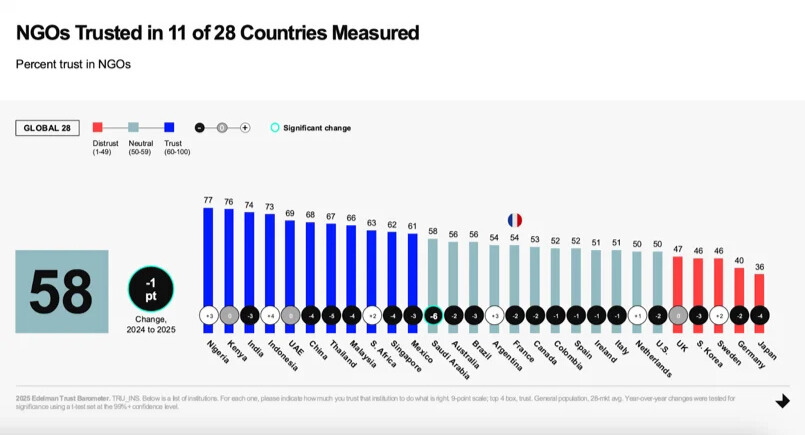
Source: https://www.edelman.com/fr/fr/trust/2025/trust-barometer
These indicators point to the same conclusion: trust in charities now depends more than ever on how the use of funds is perceived.
For charities, this marks a significant shift. Credibility no longer relies solely on reputation or longevity, but on the ability to clearly demonstrate impact in a concrete and accessible way.
2. Barriers to giving and donor expectations
The 2025 edition of the Trust Barometer in Charities and Foundations conducted by Don en Confiance reveals that:
-
65% of respondents say that “a lack of clarity about how funds are used is a major barrier to giving.”
Today, donors expect proof that their donation has genuinely supported the cause presented.
The same study lists 5 key criteria, according to the French public, for inspiring trust:
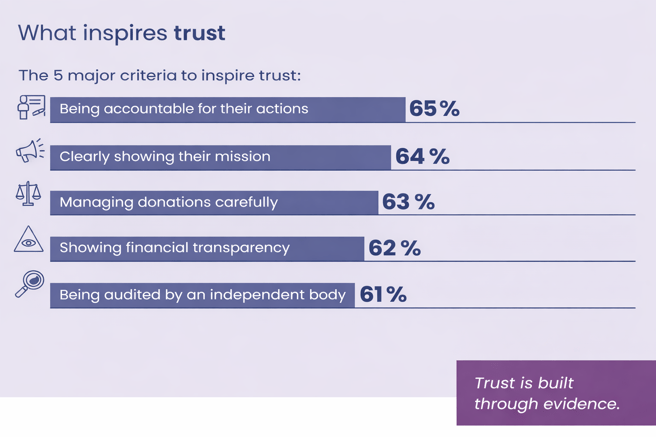
In the United Kingdom, the report “Public trust in charities 2025” published by the Charity Commission for England and Wales, identifies the main drivers of trust. The top three factors are:
-
In first place, cited by 53% of respondents: Most of the funds raised are directly used for the causes supported by the charity.
-
In second place, cited by 45% of respondents: The nonprofit makes a real difference for the people and communities it serves, particularly by achieving its stated mission.
-
In third place, cited by 39% of respondents: It is easy to see how much the charity has raised and how that money has been spent.
The same pattern can be seen in the Netherlands, where a study conducted by ABN AMRO shows that transparency is crucial for one in four Dutch people, that 45% tend to believe charities spend too much on “overheads,” and that almost a third are not sure their donation was used properly.
In the United States, the study “Gen Z at the Table: A Special Edition of The Next Generation of Giving” report by Blackbaud highlights the motivations behind giving depending on the type of engagement: donors, volunteers, advocates, and promoters.
Trust in the nonprofit ranks first for donors and promoters, and second for volunteers and advocates. For the latter, the primary motivation is that they believe in the cause.
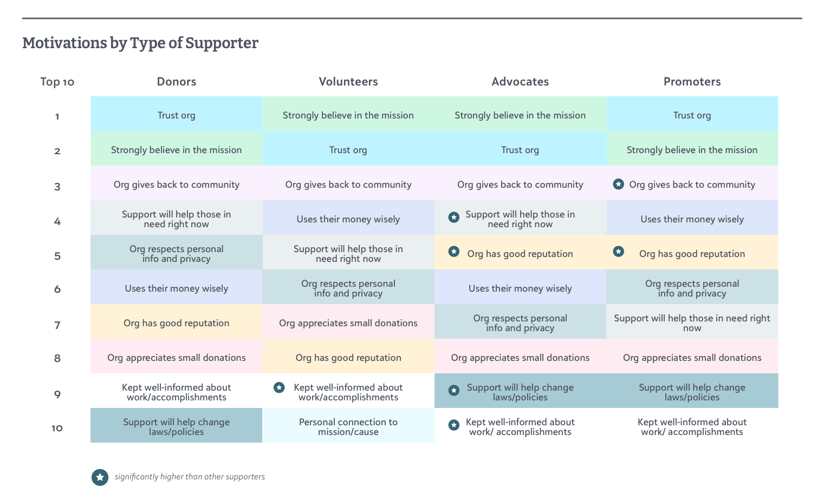
Source: https://institute.blackbaud.com/resources/gen-z-at-the-table
Taken together, these studies show that transparency around how funds are used lies at the heart of donor trust. Beyond being a moral or regulatory obligation, transparency is becoming a true fundraising driver. It directly influences the decision to give, donor retention, and the overall perception of the organisation.
Concretely, donors today expect:
-
to understand where their money goes,
-
to see the results achieved, through accessible reports and clear tracking of funded projects,
-
to easily access clear and understandable impact information,
-
and to receive regular proof and communications about the impact of their contributions.
This expectation of transparency is present at every stage of the journey: on donation forms, in online fundraising campaigns, annual reports, and post-donation communications.
3. How younger generations (Gen Z, millennials) are redefining the donor relationship
These expectations are particularly strong among younger generations, who are gradually redefining how people engage with causes.
The behaviour of young donors (Millennials and Gen Z) differs from that of previous generations, not because they are less generous, but because ways of giving have evolved, new technologies have emerged, and motivations have changed.
In its study, Blackbaud highlights several elements specific to Gen Z:
-
Out of the 1,008 people surveyed (all belonging to Gen Z), 84% say they support a cause. Among these 84%, only 19% support a cause as donors (by making one or more financial donations to one or more charities).
The report highlights different forms of engagement:
-
volunteering,
-
advocacy,
-
or sharing and promoting content on social media to increase the visibility of a charity and/or a cause.
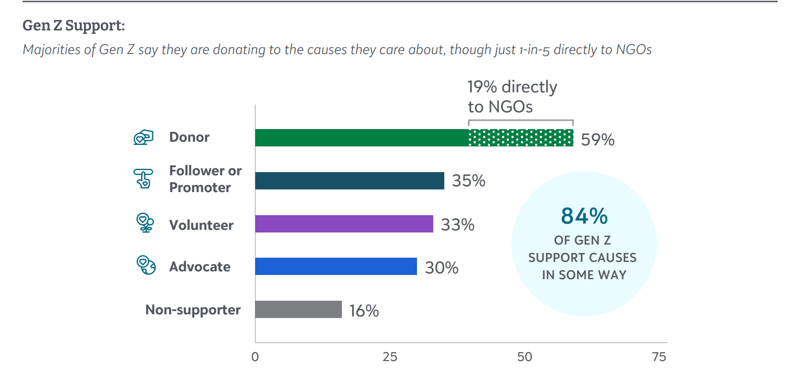
Source: https://institute.blackbaud.com/resources/gen-z-at-the-table
Looking further, when asked: “In the past 12 months, how have you supported a nonprofit organisation, charity, and/or cause?” the top three answers were promotional actions:
-
25% followed a charity or cause-related account or reposted content on social media,
-
25% signed a petition, sent an email or a letter, or shared a link on social media,
-
21% showed their support by wearing a T-shirt or putting a sticker on their belongings (bike, car, computer, etc.).
Focusing on the 19% who identify as donors in this study, we also see that forms of giving have changed. The Blackbaud report shows that:
-
4 in 10 made a donation at checkout, such as round-up donations,
-
30% donated during an event,
-
29% donated on a charity’s website via its online donation page,
-
26% made a purchase where part of the proceeds went to a charity,
-
23% donated via social media.
Finally, it is worth noting that even though only 19% of Gen Z members give directly, the majority remain engaged and support one or more causes in different ways.
The study also reports that one third of them would like to increase their donations, and when asked why they have not donated, 48% cite lack of financial means as the main reason.
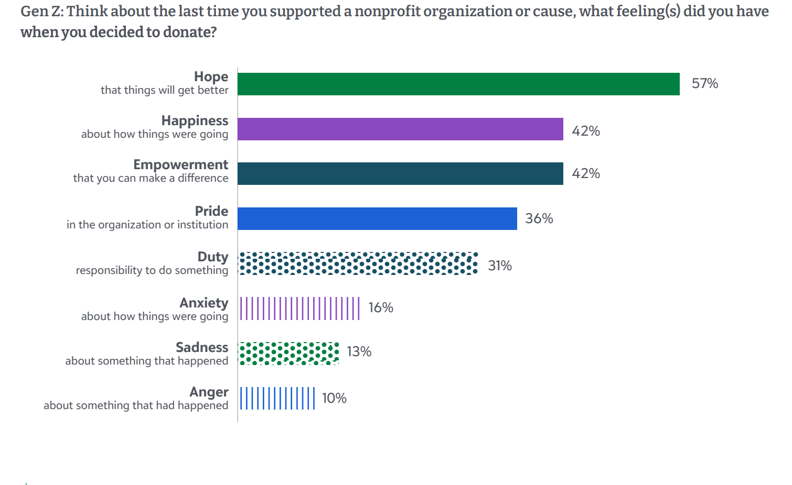
Source: https://institute.blackbaud.com/resources/gen-z-at-the-table
New generations: beyond immediate giving, thinking long-term relationships
These studies show that younger generations support causes in different ways:
-
by giving their time,
-
by sharing messages,
-
by taking part in actions,
-
by mobilising their networks, friends and family, etc.
For charities, this requires a shift in perspective. Even if younger generations sometimes give less today, you should not overlook the long-term potential they represent.
Even if their first donations are modest, focus on the “lifetime value” of your young supporters. Their early interactions with your cause (donations, social media sharing, participation, community fundraising events, volunteering, etc.) can become the foundation of lasting relationships that can grow over time.
What this means for your charity fundraising strategy
The studies all point to the same reality: donor trust is actively built. It now relies heavily on transparency and proof of impact, but also on the simplicity of the donation journey and the consistency of nonprofit actions.
For organisations, the implications are concrete:
-
Trust can no longer be assumed: it must be demonstrated through accessible information, proof of impact, and regular communication.
-
Donor behaviours and expectations are evolving, particularly among younger generations, who favour more diverse and progressive forms of engagement.
-
The donor relationship is increasingly becoming long-term, with a focus on support and relationship-building, rather than a succession of one-off donation appeals.
In this context, strengthening transparency becomes a structural lever to integrate into your fundraising strategy: it helps reassure, retain, and give meaning to the act of giving. For charities, this means evolving practices:
-
better explaining how funds are used (on your donation forms, reports or fundraising pages),
-
making impact more visible,
-
simplifying donation journeys,
-
and nurturing relationships with different audiences, including those who are not yet giving.
You now understand why transparency is more than just a communication issue: it helps secure trust and build lasting donor relationships.
To discover other key trends that will shape fundraising this year, from hybrid fundraising events to peer-to-peer charity fundraising, read our article: 10 top charity fundraising trends to watch in 2026.