


Online fundraising is all about receiving donations. Yet, a supporter can sign a digital petition on their morning commute. Another shares a video campaign on LinkedIn, while a third completes an online gift after seeing a friend's peer-to-peer challenge.
In traditional fundraising models, often, only that third action triggers a welcome sequence. The petition signers and social advocates are often filed away until a general fundraising appeal goes out, or forgotten altogether. At least, for many years, that’s been the bottomline. Furthermore, a monetary gift from a donor has traditionally meant an endpoint.
Fundraising teams bring immense passion and goodwill to their work, yet structural habits can hold them back. Most fundraising systems grew around that first transaction: the campaign sprint, the urgent call to action, the initial gift. Every digital touchpoint is optimised to land that immediate donation. Meanwhile, every other moment, from the first like on a social channel to the quiet space between donations and after campaign ends, where a meaningful connection could take root, remains empty.
Building a relational fundraising strategy delivers a kinder approach to supporter care while securing your charity's long-term sustainability. Nonprofits that invest in genuine donor relationships rather than relying solely on continuous donor acquisition retain more supporters, increase donor lifetime value, and build an authentic community that holds steady even when a single campaign misses the mark.
Here is why that transition matters now more than ever, and how your team can start making the shift.
Key Takeaways
-
The pre-donation journey matters: A supporter's first touchpoint is rarely a donation form; micro-actions like petition signatures, resource downloads, and social shares form the foundation of long-term ambassadorship.
-
Retention reality check: According to Gitnux research, sector-wide first-year donor retention sits at 18%, meaning almost four out of five first-time donors never give a second time.
-
Evolving donor expectations: Gen Z and Millennial supporters look for clear impact, personalised communication, and dynamic engagement over static transactional appeals.
-
Recurring giving as anchor: Moving a supporter into a regular giving journey fundamentally shifts their relationship with your cause from a one-off transaction to continuous partnership.
-
Actionable data: A clean CRM foundation makes true donor stewardship possible at scale, turning raw data into meaningful, human conversations.
Fundraisers are still often seeing donors as single transactions
Aligning your fundraising strategy with modern donor expectations
Why donor retention is key to long-term sustainability
Building a relational fundraising strategy across the donor journey
Where to start: practical next steps
Conclusion: Donor relationships are your most valuable asset
Fundraisers are still often seeing donors as single transactions
Picture a typical online donation experience today.
A supporter discovers your cause through a peer-to-peer challenge, a social post, or a friend’s recommendation. They tap through to your donation form, complete an online donation, and receive a standard confirmation receipt. Three months later, they receive a cold seasonal appeal. If they give again, they are marked as retained. If they don't, they sink into the lapsed category until the next mass reactivation campaign.
While the transactional model brings in initial revenue, it carries a heavy financial trade-off by treating the gift as the finish line instead of the starting line.
Sector data from Gitnux research consistently highlights this challenge: first-time donor retention in Europe averages at 18% in early 2026. So, over 80% of new supporters walk away after their first contribution. The initial investment in creative campaigns, media spend, digital tools, and staff time is rarely recouped on a single gift.
Yet, many charity fundraising budgets remain heavily slanted toward acquiring new donors rather than nurturing existing ones.
Acquisition offers visible, immediate growth; lost donors feel like a quiet, uncomfortable reality. However, the underlying economics tells a clear story. Deepening a relationship with a supporter who already trusts your organisation and knows your impact is far more cost-effective than starting from scratch with a stranger. Transactional fundraising delivers quick wins on a quarterly dashboard, but over a multi-year horizon, it quietly drains organisational momentum.
Aligning your fundraising strategy with modern donor expectations
Supporter expectations have evolved rapidly across European markets.
Research from many European countries suggests that donors feel stronger loyalty toward organisations that communicate with them as individuals rather than entries on a mailing list. There’s a growing demand for transparency, specific impact reporting, and authentic dialogue.
While these trends span every demographic, they are especially prominent among younger generations.
Gen Z and Millennial donors connect differently
Gen Z and Millennial supporters care deeply about authenticity; they spot automated or impersonal communication quickly. They notice when copy stays generic despite a personalised subject line, and they actively seek out causes that make them feel like active partners.
Their giving habits reflect this shift. Monthly recurring gifts feel as natural to them as a digital subscription, especially when framed accessibly (e.g., "Support this work with €10 a month" rather than "Commit to a regular direct debit").
Young donors usually build loyalty through small, human interactions: a personal follow-up story after a peer-to-peer campaign, a thoughtful reply to a comment on Instagram, or a warm note celebrating one year of support.
This reflects a much broader evolution in digital fundraising. Today, supporter journeys are non-linear: trust takes time to build, and younger donors interact with causes across social feeds, peer network challenges, and community stories long before making a financial commitment.
To discover how Gen Z is redefining online fundraising engagement and learn how to adapt your fundraising strategy to these non-linear touchpoints, read our article: How trust and new donor behaviours are reshaping online fundraising.
Why donor retention is key to long-term sustainability
Many charity reports concentrate almost exclusively on immediate top-line revenue: total funds raised, average gift size, and campaign targets. Far fewer track donor retention as a key strategic health metric.
Focusing solely on acquisition creates a costly blind spot, but the maths of donor stewardship is compelling. A supporter who gives consistently over five years yields a far higher return on initial acquisition costs than five individual donors who give once and vanish. Retained donors are also far more likely to become regular givers, advocate for your cause, participate in community fundraising events, and consider legacy giving later in life.
Industry research consistently demonstrates that a 10 percentage point increase in donor retention can yield a dramatic rise in total lifetime value (source: Research by Dr. Adrian Sargeant | AFP/Wiley Fund Development Series). Retained donors form the stable core of your financial planning, allowing your organisation to innovate and plan ahead with confidence.
Building a relational fundraising strategy across the donor journey
Shifting from transactions to relationships allows you to keep active campaigns running while making simple, intentional adjustments at pivotal moments across the full supporter lifecycle.
1. Honour pre-donation micro-actions
A supporter's relationship with your charity rarely starts on a donation form. Signing a digital petition, downloading a guide, or sharing a campaign post represents a meaningful investment of trust and intent.
Treating these non-financial touchpoints as vital entry points transforms how your organisation builds its community:
-
Deliver instant gratification: Send an immediate, warm confirmation that celebrates the specific action taken (e.g., "Thank you for adding your voice to this petition, here is how your signature helps").
-
Share impact before asking for money: Follow up non-monetary micro-actions with short stories or project updates showing progress on the issue they engaged with.
-
Invite ambassadorship: Encourage supporters to share the campaign with friends or join an online discussion, validating their role as advocates before introducing a financial ask. A collection of small steps will improve your relationship.
2. Make the thank-you moment transformational
The 48 hours following a first gift represent the highest engagement window you will ever have with a new supporter. They have just taken action for a cause they care about. They are attentive, inspired, and listening.
Yet, many charities use this vital moment merely to deliver a system-generated tax receipt.
A relational thank-you email lands quickly, confirms the details cleanly, and immediately invites the supporter into the story. Share a brief beneficiary update, a quote from a project lead, or a short note on how their contribution is being put to work. Closing with a welcoming message, such as "Over the coming months, we look forward to sharing regular updates on what your generosity is making possible" sets a clear expectation of an ongoing relationship.
Looking for a resource to help you transform your thank-you emails and email flows into lasting relationships, especially with young supporters? download our guide: Charity fundraising: 4 strategies to engage and retain Millennials and Gen Z.
3. Segment with intention (and leverage RFMC data)
Treating every donor identically dilutes your message and risks donor fatigue. Modern supporter communication needs to feel qualitative, highly relevant, and acknowledging of the donor's unique relationship with your cause.
Moving beyond basic email lists means applying an RFMC approach (Recency, Frequency, Amount/Monetary, and Channel). Modern fundraising platforms and CRMs allow charity teams to easily build dynamic segments using these core criteria:
-
Recency & Frequency: Distinguishing between first-time givers, active monthly supporters, and lapsed donors to time your touchpoints effectively.
-
Monetary value: Grouping supporters based on single gift sizes or cumulative lifetime giving (e.g., donors who contributed € 1000+ this year or € 5000+ over their lifetime) to tailor the ask appropriately.
-
Acquisition & preferred channel: Tracking whether a donor joined via a peer-to-peer marathon, an online crowdfunding page, or organic search.
A supporter who joined your journey through a colleague's peer-to-peer fundraising challenge has a very different emotional connection than a major donor who arrived through direct search. Using granular RFMC data to personalise both the context and the body copy proves to donors that you recognise their real commitment, drastically improving email engagement and long-term donor retention.
4. Build a dedicated recurring giving programme
Offering a monthly option as a simple toggle on a donation form is a great start, but creating a structured, dedicated recurring giving programme is what unlocks true donor retention.
A structured programme offers:
-
A warm, dedicated welcome sequence explaining the sustainable, long-term impact of monthly support.
-
Regular, concise impact updates tailored specifically for regular givers, showing them how their continuous partnership makes a difference.
Example: In France, the Fondation pour le Logement des Défavorisés launched a monthly-giving initiative starting from € 8/month to support people facing housing insecurity.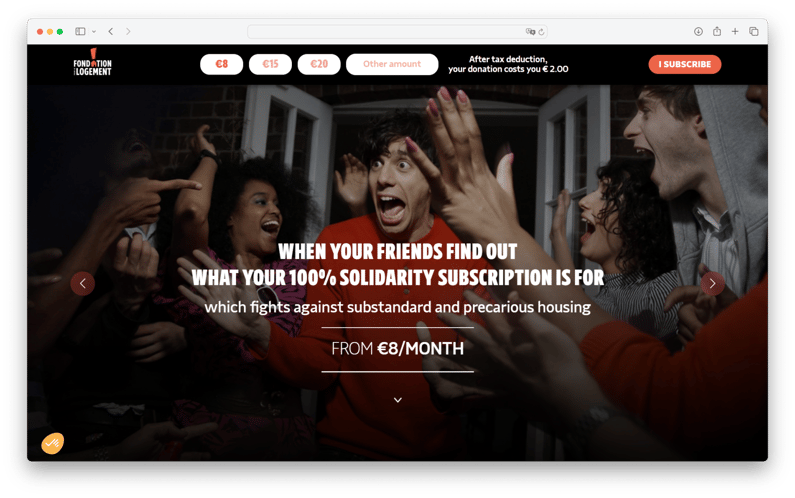
Rather than relying on a standard donation form, their dedicated page clearly illustrates what each subscription tier achieves, shares authentic testimonials from beneficiaries and donors, and highlights key impact figures. This clear, reassuring approach turns a basic recurring option into an engaging, trust-driven giving community.
5. The strategic role of CRM and supporter data
To nurture donor relationships at scale, clean data is essential. Without a clear, centralised overview of how supporters engage with your charity, true personalization remains an intention rather than a reality.
Whether you use an enterprise CRM or a specialised non-profit database, your CRM serves as the engine for your relationship strategy. Its real power comes from consistent maintenance and active integration with your online giving tools.
Practical ways to leverage donor data for stronger relationship building:
-
Track engagement beyond gifts: Monitor email opens* , resource downloads, and event attendance. A donor who opens every monthly newsletter but hasn't given in 12 months is actively interested and ready for a thoughtful touchpoint, rather than a generic lapsed donor blast.
-
Log non-financial interactions: Record volunteer activity, petition signatures, and campaign participation. Recognizing a supporter's broader involvement proves that you value their overall commitment beyond financial contributions.
-
Identify attrition risks early: Use giving history to spot sudden changes in donation frequency or payment failures, allowing you to re-engage valued recurring donors before they drift away.
Focusing on donor data simply ensures that existing supporter insights inform every conversation you have with them.
*Note on data compliance: Following updated privacy guidelines in some European countries like France and Italy, tracking email opens via tracking pixels requires a dedicated opt-in.
Where to start: practical next steps
Charities can begin this shift immediately through five practical steps this month:
1. Review your post-donation touchpoints: Test your own giving journey as a first-time donor. What is the immediate follow-up message? Ensure your automated receipt is immediately paired with a warm welcome note and a clear impact update rather than a secondary donation appeal.
2. Review your thank-you messages to ensure the language sounds warm, human, and genuinely appreciative rather than transactional. For creative ways to go beyond traditional receipts (from personalised thank-you pages to impact milestones) explore our article on 13 creative ways to show donor appreciation.
3. Formalise your recurring donor journey: Design a dedicated welcome sequence and an annual milestone acknowledgment for monthly givers.
4. Evaluate campaign performance beyond total income by analysing metrics like conversion rates, average gift size, and multi-gift frequency. To simplify this process, you can download our Ready-to-use fundraising report template, it features a ready-to-use campaign reporting spreadsheet to help you review key performance indicators and identify what to repeat, improve, or abandon.
5. Give donors active ways to participate beyond financial gifts by integrating interactive tools like charity crowdfunding, or other Community Fundraising initiatives. Looking for creative inspiration to launch your next campaign? Download our Fundraising Calendar to plan seasonal and engaging key moments throughout the year.
Conclusion: Donor relationships are your most valuable asset
A single donation is a wonderful moment, but a sustained donor relationship is a transformative asset for your mission.
The most resilient non-profits, those that thrive through economic shifts, sector changes, and evolving digital landscapes, are built on strong, lasting relationships with their community.
Charities can start this shift through deliberate, human-centred adjustments: monitoring more than just monetary value, appreciating every single micro-action, a warmer thank-you email, an engaging welcome journey for regular givers, and thoughtful use of existing donor data.
To go further in building sustainable donor relationships and explore how to foster viable donor engagement, explore our article: Online fundraising: from first gift to lifelong support.